Tuesday, March 24, 2009

Kochkor, Part I: Mountains, snow and an inventory of things broken

Bishkek: Mountains and Snow

After my trip to Bangkok during the Thai winter, which turned out to be warmer than any summer I’d experienced, I left all my warm-weather clothes with Maggie as I packed a suitcase for winter of the Central Asian variety. Long underwear, two coats, gloves, hat, mittens, sweaters, thick trousers, and no socks not made of wool.

An aside – the damn thief who broke into Maggie’s apartment the day before my departure, stealing all electronics in sight, also made off with all but a few pairs of my underwear. It is proving exceedingly difficult to fill the void left by this jerk in a city where, I’ve learned in a few underwear shopping excursions, women will only wear nylon underwear with cute little sayings like “Don’t hate me cuz…”

So the weather. Here I come to Central Asian winter with two coats, snow boots and wool socks. And what do I find? Half the time it is warmer than a Michigan spring. One day I threw on a layer of long underwear in the chilly hours of the morning only to nearly suffer from heat exhaustion around lunch time. A few days later, I make a snap decision to wear my fleece instead of my wool coat and end up jogging home from school to keep warm. The weather here could be described as unstable.

I think this instability has something to do with this beautiful view from my bedroom window.


There’s been snow on and off as well, rarely staying long enough to be worth looking at. Here is a taste:


The only thing that changes for me when it snows is that I have to lie to my host family, promising to take the marshrutka instead of walking the 30 minutes to school. I tried explaining that I come from a place very close to Canada and can handle an inch of snow. This line of argument has been so far unsuccessful. Everyone thinks it is ridiculous that I enjoy a morning stroll instead of paying 20 cents to pack into a smelly, hot van with 50 of my closest Bishkek friends. It is so packed that you can’t even look out the window to see if you’ve passed your stop. I can understand why my host family is concerned for me. You probably don’t know this, but in Kyrgyzstan, merely walking in the cold can make you terribly ill. So can eating ice-cream and drinking cold water, for that matter. I believe that it has to do with Kyrgyzstan’s unique climate, geographic coordinates and lack of a comprehensive science curriculum. Come to think of it, this can also happen to you in Turkey. In this way, both of these countries are something like the St. Ignace Mystery Spot. The world may never know.


Broken Hopes in Broken Russian in Kochkor

Everyone knows it doesn’t snow in Kochkor. After all, its name means “Go away snow,” or something to that effect, in Kyrgyz. So when someone inquired at the Bishkek branch of Community Based Tourism in Kyrgyzstan, they naturally suggested it as an acceptable mid-March weekend getaway. I set off Saturday morning with Daniel [of “small vodka” fame], Brian and Kristen, three of the American teachers here.

As we drove to Kochkor, we were abuzz in the taxi. Rumor has it that in the villages outside of Bishkek, hardly anyone speaks Russian. We are very concerned that the Kochkor villagers will not be able to understand us when we speak Russian with them. Kristen says her students warned her about travelling to Kochkor without a Kyrgyz speaker. We are indeed concerned. We are indeed excited.

I sit a little taller, knowing that through my knowledge of Turkish and my 2 week stay with a Kyrgyz family, I can say such Kyrgyz phrases as “I’m full,” “May there be good digestion,” “Welcome,” “Since I arrived,” “no,” and “weak tea.” Well, that list ended up being a bit more exhaustive than I had originally intended. Hope you didn’t spend too long reading it; here’s a promise to be more concise in the future. In a nutshell: I am looking forward to being the resident linguist on the trip.

The anticlimax: Of course, we ended up being the only people in town who didn’t speak Russian. Whenever we attempted to communicate, the locals would respond rapid-fire and we would pretend to understand and say “no” if it sounded like a question. Someone who shall be identified only by his out-of-date lens prescription had a conversation in Russian with a sweet young boy who gave us directions into town without realizing the boy had Down’s Syndrome.


Kochkor: Mountains and Snow

The mountains in Kochkor were beautiful – a layering of red, black, brown and white. We arranged for a driver to pick us up at our homestay at 9:30 on Sunday morning, drive us to the mountains, pick us up again a few hours later, and drive us back to Bishkek in the afternoon. I know this sounds decadent in such times of economic crisis, but it really isn’t that much more expensive than taking the dreaded marshrutka, and cuts travel time in half. He showed up at 8:50 itching to get back to Bishkek, and was cross with us the rest of the day.

He dropped us off at the base of the hills and suggested we hike up to some metal thing not too far away which he referred to as the TV tower. He spoke a good deal of English and also asked if we thought Kochkor was a “delight.” Unfortunately, the TV tower was guarded by two particularly astute guard dogs. Luckily, we had a contingency plan to follow the river for awhile and kick dust around on some really big hills.

This is me kicking dust around with layered mountain background:


This is Kristen, probably doing something similar, with big mountain background from the other direction:


This is the picture I am going to send to the Kochkor city council, demanding they change their misleading name:


Do you see those white clumps to the right of the river?


Kochkor, to be continued: a spring holiday, lots of children and my first Kyrgyz souvenir.


Tuesday, March 17, 2009

Water, hot and cold, with cups, and without conveniences

I am an American prude in the puritan spirit, so while I may be fascinated by public drinking and political sex scandals, I simultaneously despise the idea of being publically naked. This is why we Americans have fear and anxiety dreams where we’re naked and can’t find our clothes, why some feel more comfortable giving a speech if they imagine everyone else naked, and why during breast exams, doctors think it is perfectly normal if we only wish to expose one breast at a time. Both at once? How embarrassing!

Aika, who I suppose I could call my "homestay sister", comes to my room while I’m doing my homework, trying to master the genitive singular case, and asks me if I would like to go to the banya. I know it will make a good blog post, and the house doesn’t have a shower, so I say yes.

“But,” she says in English, “I don’t know if you’ll like it. It is water, hot and cold, with cups, and without conveniences.”

I establish that there will be no more than a few people inside at once. She tells me it is their own private banya, and while they used to allow other people to use it for a fee, now it is just for their family.


The Banya


Now I am well aware I am not the first white girl to go to Central Asia and get weirded out in a banya. Yet the story seems worth relating anyhow.


The banya has three rooms – a cold room for changing, a warm room with hot and cold water for washing, and a steam sauna. Aika is nowhere to be seen, and I find myself in the sauna with her mother. First we entered the sauna and steamed for awhile while massaging ourselves with black salt. This was, at times, a team effort. A few times she threw water onto the heater and then would instruct me, with a strong sense of urgency, to sit or lay in various positions to allow the steam to take maximum effect, cleansing various anatomical regions. With my back on the damp wooden bench of the sauna, I remembered Aunt Grace's story of sauna contracted scalp infection. I make a mental note to google the Patron Saint of communicable diseases for future reference.


The Mother-in-Law's stare


Then into the warm room. Warm and cold water, with cups and without conveniences. Accurate description. I'm scrubbing relentlessly with my bright green Chinese exfoliation mitt, purchased at the market for about 45 cents, acutely aware of Host Mother's not so subtle stare. It's been relentless since the sauna.


This immediately brought to mind the story of one of my favorite Turkish teachers in Istanbul, Zeki Bey. He told us once of how mothers helped their sons choose wives back in the “good old days.” The son may see the face of a beautiful girl in the window of her house. But because she is not allowed to leave home, the boy has no way of seeing any more of her. As Zeki said, “Maybe she only has one leg! Maybe there is some problem with her arm.” You wouldn’t want to choose a wife with a beautiful face but an…undeveloped body.


So, the son would tell his mother who he had his eye on. The mother would go to the hamam, with the rest of the village women, and scope out the potential daughter-in-law. She would determine whether or not the girl was missing a leg, an arm, or child-bearing hips. After hearing the report from his mother, the son could make a more informed decision.


Although I know that my host mother has no intention of marrying me off to her son, this is how I felt in the banyo.


“Are your mother's [indecipherable Russian word (IRW)] like mine or [IRW] like yours?”


Usually I am pretty good at guessing out of context, but horrified as I was, I think I just made a confused face.


This time with very specific miming, gesturing and pointing: “ARE YOUR MOTHER’S [IRW] [IRW] LIKE MINE OR [IRW] LIKE YOURS?!”


As Nargiza told me in the "Everything I Need to Know I Learned in Kindergarten" lecture, family is very important in Kyrgyzstan. This question asked to someone who is easily embarrassed during breast exams. I don’t know what I said, but she replied “Good.”


A bit later, she points to my knee and says [Indecipherable Russian sentence (IRS)]. I curse myself for not being on top of leg hair removal. I open my mouth and say [nothing]. She points again, and I see she has noticed a scar the size of a watermelon seed I don’t think I’ve ever even noticed. This is Elizabeth’s naked nightmare.


The Verdict


Back to the sauna. More acrobatics to take full advantage of the steam. Back to the other room for more exfoliation. I'm scolded for using soap too soon, and not using enough water. "We have lots of water!" More humiliation by visual examination. She insists I haven't washed my back enough and does it herself.


I'm finally finished and have lost a few pounds in dead skin and water weight.


At dinner, Host Mother smiles at me. Would it be projecting to add the adverb knowingly? I try not to picture her picturing me naked. Just when I convince myself she's only being friendly, she hands me the bread basket.


"Eat more bread!." Another [IRS] while she outlines a not so charitable womanly profile she claims to be me. "You're too skinny."


Will I go next week? Of course. Public humiliation is a small price to pay for such a fantastic spa treatment.

10 points to whoever could guess what the most embarrassing part was. Through email only, please.

Thursday, March 12, 2009

Russian 101: Водка

Remember my mention of the helpful cognates I’m encountering on my adventures in Russian? Well, here is one I’m sure no one is surprised to learn: Водка (n Vodka).


Before travelling to Bishkek, my friend David gave me Colin Thubron’s Lost Heart of Asia, an account of his trip through Central Asia in the early '90's. At the beginning of the book, he tells quite a few tales of getting caught up in drinking sessions, his guides and travelling companions red-eyed, slurring their words, etc, etc, etc…About a quarter of the way through the book, he’s no longer mentioning excessive consumption of alcohol, or any alcohol consumption at all. I figure our friend Colin has figured out a way to avoid this fast track to cirrhosis altogether, and is spending the rest of his book bonding with his new friends over shashlik instead of vodka toasts. Later on in the book, perhaps sometime after Uzbekistan, he is in the middle of describing another proverbial night around the fire, fingers greasy from shashlik and eyes cloudy from the smoke. “Then,” he writes, “we realized we were out of vodka.” Of course.

This reminded me of the stories of my Turkish teacher in Istanbul, who was always reminiscing about his days in Tashkent, where to decline a drink of vodka was as unthinkable for the Uzbeks as it is for the Turks to refuse to sit down for a tea with a friend.

I have no strong affinity for vodka, but there is something about "vodka culture" that is difficult to not find intriguing.

I hesitate for fear of speaking too soon, but aside from the cheap and abundant liquor, there are less obvious signs of post-Soviet drinking culture in Bishkek than I had anticipated. Bottles of empty beer cans at bus stops – no. Adolescents at night clubs passed out at the bar – of course. Business men and women drinking a can of beer on their way to work – no. Compared to Ukraine it seems almost puritan. Drunk policeman, eating in the same restaurant as you, trying to engage a table of foreigners by shouting who knows what while laughing hysterically, yes. Or maybe I should withhold judgment for the time being.


----


In my pre-Bishkek research, I came across the following piece of odd information in the Central Asia Lonely Planet:


Remember, in Bishkek you are never far from a shot of vodka. For those too
busy to actually go inside a bar, most street stalls sell ‘kiosk shots’ (also
known as juice grams) of vodka or cognac for 5 som a nip.


Never mind that this was talking about street stalls, I couldn’t help but imagine that this important societal role was filled by a specialist: an old, quiet man, sitting on the side of a road with a table, bottle of vodka, shotglass, and dirty rag. In short, a vodkaci.

I kept my eyes peeled during my first week in town, not because I fancied a vodka shot in broad daylight, but because my American upbringing has left me absolutely fascinated with the sociological nitty-gritty of drinking in public (and legal prostitution).

After a week without success, my flatmate Daniel and I set out to locate this elusive vodkaci on Saturday. Yes, it really is that uneventful here.

Unfortunately, we could not find the devoted vodkaci of my romantic daydreams. We instead settled for going to a small kiosk selling snacks, soda, and a wider selection of alcoholic beverages than your local Wal-Mart.


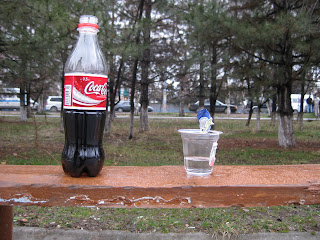
Unable to translate “kiosk shot” into Russian, and certain that “juice gram” was just another piece of Lonely Planet garbage, we asked the woman in the kiosk for a “small vodka.” Actually Daniel did, while I tried to hide around the other side of the bus stop.

She knew exactly what we were getting at, and gave us a small plastic cup with foil as a lid (think: the plastic cup of water you get in-flight). This cost 14 som, a bit more than the “5 som a nip” promised in the L.P. This cup held 100 cl. I’m not so great at metric conversions, but that seems a bit more than a “juice gram.”

Currency conversions, on the other hand, are a bit easier: 35 cents. Given that Daniel and I split the foul liquid of our sociological experiment, that is about 17.5 cents each.

Foul, foul indeed. But all in a day’s work as an unemployed studientka, getting by one cognate at a time.


Home away from Home?

I moved into a homestay Tuesday. The jury is still out on whether or not it was a good idea.

I first went to see the homestay last week with Nargiza, the manager of the school. We saw two families. The first is a Kyrgyz family, with a mother, daughter and son. They showed me around the house, which was quite large (even a library!).

We sat down at the kitchen table to have a conversation, of which I understood almost nothing. The mother kept telling me she wanted to know “everything” about me and my life in America. Nargiza was constantly translating, but seemed to be leaving quite a bit out. The mother told the daughter a few times that she could practice her English with me. Nargiza didn’t bother to translate this. When the pleasantries expired and I was adequately stuffed with cake and hospitality, we left.

Next we stopped by another family, this one staying in a small, cramped apartment. They were an older Russian couple. I am no expert at Russian accents, but I got the feeling theirs was much closer to the one I want to be learning. Did I mention that the mother of the first family sounds the same whether she is speaking Kyrgyz or Russian? But the apartment was a lot smaller. And I guess they were bordering on the edge of being “old” instead of “older.” Seemed weird. I choose the first one.

After signing the contract and paying for my first month’s rent, Nargiza told me she wanted to tell me a little bit about “Kyrgyz culture.”

“Do not make friends with any peoples who talk to you on the street.” All I need to know in life I learned in kindergarten. I agreed to not be an idiot.

She drove me to the homestay, about a 10 minute drive from the school. I was welcomed with a gusto somewhere in between hotel manager and distant relative. I’m paying $10 a day to the school for this “authentic Kyrgyzstan experience.” For this $300 a month, you can rent your own flat in Bishkek, or two or three, depending on how far out of the city you want to go and how much you care about luxuries like heat and electricity.

This family seems quite entrepreneurial; they run a market in front of their house and the mother is frequently travelling to China on business. I hope they’ve bargained hard with the school. I’m still angry about paying the school $8 a day for a room next to a classroom with no sink or bed.

Nargiza leaves me, worried I think, and says goodbye to the family. I move into my room and settle in. First thing I noticed was the beautiful view of the mountains from my bedroom window. Next this was the lack of central heating, which wasn’t as apparent in my visit during last week’s heat wave (fleece instead of wool coat!). Next problem arose when I inquired as to the location of the shower. Another thing Nargiza forgot to translate. They are renovating their bathroom, so they shower at their aunt’s house. Or go to the public bath on Sunday.

Dinner was quite good – a cross between vegetable borek and a steamed dumpling, like a cinnamon roll with carrots and onions instead of cinnamon and butter, but steamed instead of baked. The only problem I encountered here is that I couldn’t convince my host mother that I didn’t want more mayonnaise. She kept squeezing out more from the bag onto my plate no matter what I said (I am not blaming this on her, my vocabulary is incredibly limited after all). She also kept asking me if I knew what mayonnaise and ketchup were. The American inside me cannot be too annoyed, as I am pretty sure it is my damn country that spread this crap around the world anyway.

The next morning breakfast was bread, homemade jam (delicious) and leftover borek/dumpling/roll. Yes, with more mayo. I was able to avoid eating the cake they tried to present by saying “I cannot eat sugar in the morning.” This they seemed to accept, at least after I added the phrase I recently learned in my lesson about clothing and fashion: “It does not suit me.”

I hope the food continues to be this good after they tire of my broken Russian at 7:30am.

Wednesday, March 4, 2009

How I saved $300 with Aerosvit and even got a complimentary blini


Keeping in line with this blog's new theme of post-Soviet adventure, I thought I'd post an email I sent to friends and family about a recent trip on Aerosvit, the Ukrainian carrier, on my Istanbul-Bangkok trip. As you may have surmised from the subject line of this post, I saved a good deal flying Aerosvit to Bangkok instead of the other cheap (Turkmenistan Air, Uzbekistan Air) and mid-range options (Gulf Air, Jordanian).

IST - KBP - BKK

The IST-BKK trip went off without a hitch, except for the fact that I spent my entire two hour layover in Kiev waiting in line for the ONE metal detector for transit passengers.

BKK - KBP - IST

The exciting story is the return flight. In Bangkok, we board the plane for our 6 am flight and wait an hour. Then we learn that for "security reasons" we must all deplane, go thorugh security again, and reboard. We all gather our things and stand up to get out. But nothing happens and we wait on the plane for 30-40 minutes. Finally they open the doors and we go through security and then wait about an hour, and we can see through the window that they are taking the luggage out of the baggage compartment and searching it. 2.75 hours after the original scheduled departure time, we are in the sky. One of the toilets don't work and all of them smell like urine. The meals (of course) are disgusting (Breakfast - egg and hot-dog and potato mash with questionable flavor. Dinner - fish that seems red on the inside and cooked on the outside, noodles and baby carrots. They have lost my vegetarian requests. Guy beside me says the same. But man in the middle row seems to be enjoying his stir fried vegetables).

Ukrainian flight attendants hide from us in the back, as they naturally want nothing to do with any request we may have. But at least they had a projector and played Jumper and 27 Dresses!


Seeing the sights in Kiev, or my evening at the Airport hotel

10 hours later I'm in Kiev. If my connecting flight left on time, I've already missed it. They've delayed some of the flights for the connecting passengers - I learn this by word of mouth, as there is no flight information board. I try to get information about my flight before I stand in the security line (Is it delayed? Has it left? When is the next flight?). You may remember from the first flight that the security line has only one metal detector, so again I wait quite a long time. If you are wondering why they only have one metal detector, perhaps you would be interested in the theory of the theory of the Swiss guy with the bargirl girlfriend who set next to me on the flight, who suggested they do this so they have ample time to search our luggage and see if there is anythign to steal.

A woman whose job seems to be communicating with foreign passengers tells me "Yes, Istanbul, upstairs." So I wait in the line for an hour. Once I get "upstairs" they tell me I have missed my connection and now I must wait for the flight at 0700 the next morning. I have to wait 3 hours (for 15-strong group of irate Israelis to stop yelling at the staff behind the check in counter... "I don't work for you, you work for me, I pay service, you help me now, this is called service, where is your manager? You are manager? I don't believe. Give me airport manager. None of your f****** bull****.") to ask key questions: Where is my baggage? (Downstairs) Will you give me food? (Yes, a fist sized sandwich and ONE cup of water) Will you give me a place to stay ? (No, but you can pay $45 to stay at the airport hotel) No longer a student, I think it is most likely not acceptable to sleep in the airport to save $45. Also I have travel insurance. Let's see if they reimburse.

Sidenote: of the 4 women behind the check-in desk, only one of them appears to speak any English besides "yes" , "no" and "wait." She just answers whoever is shouting loudest at her at the time. And if in the middle of a conversation someone shouts louder, she shifts her attention. Also there is no line for the check-in desk. There are two really angry Indian guys who keep shouting that they want to go to New York. I see no flight for New York scheduled on the flight board (yes, you can finally see the flight board after you pass through security).

The Aerosvit employee got some guy to help me get my luggage. She suggested I get my luggage immediately rather than trust they will be checked tomorrow because "Sometimes night staff, they make mistake with bag." Yikes. So this guy goes and bypasses all these rules and regulations (violating security codes that I am sure Ukraine must have - like bringing me in and out of secured areas without checks) to get me my bags, out of passport control, and ready to go to the hotel. So finally I get on the bus to the hotel airport, get ot the airport, check in, watch some TV and mess around with my luggage, and crash. Thank you jetlag, I am then up naturally at 3 am. Complimentary breakfast at 4 - with blinis! Bus to airport at 5 (actually it is only a 2 minute bus ride, but still, I don't have proper shoes for Ukrainian winter, and why the hell would you make an airport hotel not attached to an airport? I dont know I haven't actually stayed at one before).


I lost you at "hello"

Hello, and other labyrinths

Before I started studying Russian, Denwood tried to ease my fears of embarking on the notoriously difficult language. "Once you get the alphabet down, it's not too different than studying a romance language."

Right. I've never studied a romance language with six cases and three genders. But I must thank you, Denwood, for giving me the confidence to start on the task, which, from my wobbly pressboard desk stacked with Russian grammar books, seems near impossible at the moment.

Yes, cognates exist. Stop/stop, stul/chair, vada/water, and they get better once you start on scientific and political vocabulary! But I'd gladly trade a handful of these gems for a word for hello I could actually wrap my mind around. For some reason Russian speakers are quite attached to greeting one another with an onslaught of consonants that goes something like Zravstvujtye. Yikes. So much for breaking the ice without verbal trippage.


First days of Russian lessons

I'm now two days and 10 lessons into this attempt, not counting of course the class in Istanbul in which we mostly joked around with our teacher about Russian and Russians in Turkish. I have 5 hours a day.

First is two hours of Reading and Listening with V. Her beauty and unique interpretation of professional attire has won her a nickname among the foreign teachers and students that I know better than to put into print. She's patient and a decent teacher, and for the record I prefer her attire to the unique interpretation of professional attire popular among 20-something TEFL teachers.

Next I have two hours of Conversation with A. Bless her heart for enduring the excruciating task of conversing with me Russian. She's Kyrgyz, and also teaches English. Let me say first that she is nice, kind and from what I've seen, a wonderful person. Let me say, with that out of the way, that she talks a bit like Barney - yes, the big purple dinosaur - teaching new words to his teething television audience.

She also wasn't able to tell me the Russian word for interpreter. "Translator," I offered, assuming the problem was with her English. "A person who writes Russian from English, and English from Russian."

"I know, I know," she said, and tried to find it in the dictionary. "I don't know Russian word."

This is my excuse if I leave Bishkek sounding like a fool.

After a break for lunch, 2 hours of Russian Grammar with J. Great teacher, doesn't waste a single moment of the lesson. She teaches only in Russian, clarifying only in English if you are completely lost. The irony in this is that she seems to be the only teacher who speaks proper English. It is a huge confidence boost to be able to communicate with her in Russian, even though she seems the only Russian speaker in the world with which I can do so.

Stay tuned

Next installment - Kvas, plov and innocents abroad. Probably.

Friday, February 27, 2009

The 'bul to the 'kek

I've just arrived in Bishkek for a 3-month attempt at learning some Russian. I hope to write about my experiences here, because my internet access will be spotty but I still want to keep in touch with friends and family.

First Impressions

At first glance, Bishkek doesn't seem that different from my hometown of Gaylord, MI. Long, tree lined roads with no street lights at night, cold, snowy, not too much going outside of the center.

I guess the things it has that Gaylord doesn't would include: Russians, Kyrgyzs, Uzbeks, Turks, etc; Soviet monuments; dirt-cheap vodka; public transportation; and international airport and a number of universities.

But in all seriousness, Bishkek feels pretty green and low to the ground. Not too many tall buildings and plenty of space in between apartments and shops.

The London School

The school organized an airport pick-up for my 3am arrival at Manas Airport. I thought I set my alarm for 12pm but somehow managed to set it for 8am. This caused much confusion in the morning. I ate breakfast in the school cafeteria. I thought I ordered eggs, but ended up with three spitting fried eggs and a piece of toast.

I've met a few of the English teachers at the school. Many of them seem to come in couples; perhaps Bishkek is not the next capital for the 20-something single.

My flat is clean and acceptable. The strangest thing about it is there is no sink, unless you count the bathtub. I woke up this morning feeling like I'd slept in a sauna. Asking in the office, I learn that the heat is "centrally controlled," not by the building but by the city. My bathroom light also seems "centrally controlled" for some reason. I also have the possibility of a homestay or renting my own apartment. Will postpone this decision for a few days.

I start classes on Monday. I will have 5 hours of lessons a day, 4 days a week. My classes will be divided among three teachers, teaching Listening/Reading, Grammar and Conversation.

Turkey (and Turkish) in Bishkek

When I first moved to Turkey, I found it impossible to restrain myself from comparing everything to my experiences in the U.S. Now that urge is easily resisted, but perhaps only because it's been replaced by another. During my travels over the past few years, I've found it difficult not to compare the places I visit to Turkey.

A friend from my days at Bogazici is now working as a journalist in Afghanistan, and occasionally visits Istanbul during work holidays. Living without electricity, minimal access to Internet connections and without many modern necessities/conveniences, he told me that living in Kabul gave him an entirely new perspective on Turkey. While he used to stock up on "Western goods" on trips home to the UK to bring back to Istanbul, now he stocks up suitcases in Istanbul to bring back to Kabul.Bishkek is no Kabul, but I think I'll find the same during my time here.

After waking up and organizing my things this morning, I went to stock up on groceries. Afraid to brave the bazaars without knowing the price of anything except the hourly cost of private Russian lessons, I decided to go to the supermarket. I went to "PAMCTOP", which I am pretty sure is MIGROS given the store design and logo. On the shelves, I see rows and rows of Turkish products. Eski Kasar, for example, is an aged cheese in Turkey that is usually 5-6 dollars a wedge. Here, however, it is a complete luxury, at a whopping $30. (That is the cost of 7 hours of one-on-one Russian instruction by a qualified teacher.) There are also Turkish sweets, juices, packaged soups and sauces, and all look like delicacies next to their Russian and Kyrgyz counterparts, whose packaging was created without the benefit of a decent graphic designer.

I break down and buy a simit. Slightly cheaper than in Istanbul. Not the same at all. I need to break away from this Turkey mindset.

When I check out, I realize I don't have enough cash. I am such a dork. The woman looks Kyrgyz, so I apologize and explain in Turkish. She understands, but responds in Russian. Luckily I am perspective and speak both "context" and "body language". I toss a few items, pay, and run home with my tail between my legs.

I can hear your sighs of disappointment. But give me a break - it's my first day. I look over my notes from my Russian class in Istanbul and promise myself no more Turkish (except for emergencies...).

All sorts of exciting experiences await me, such as..."Damn, I bought the fizzy water again."